


 Shkruar nga Pamfleti
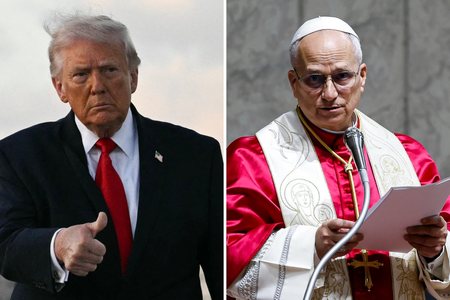
The head of the Catholic Church, who has repeatedly called for an end to the conflict in Iran and Lebanon, has been sharply criticized by the American president.
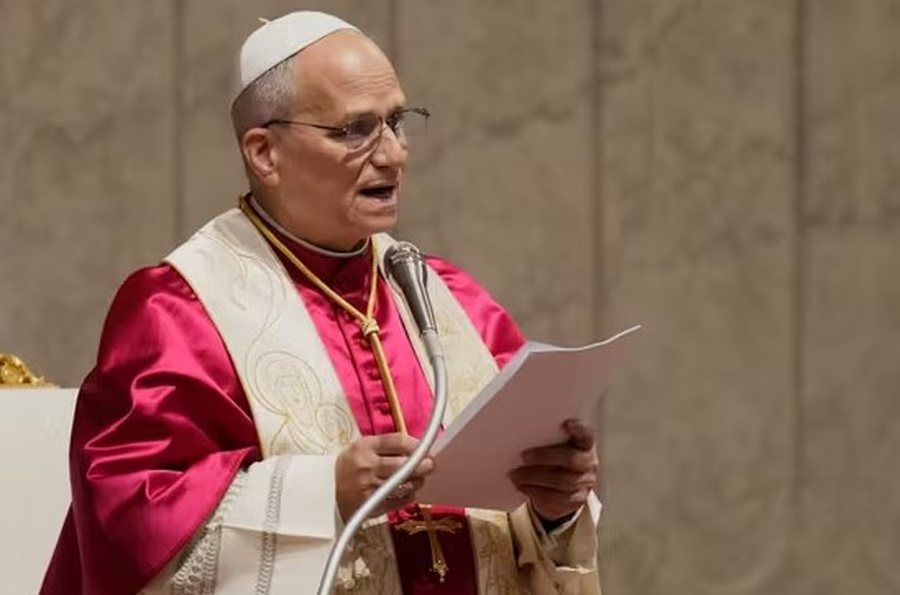
The members of the diplomatic corps took their seats in St. Peter's Basilica on Saturday evening, April 11, next to the cardinals and bishops. Clergy and ambassadors to the Holy See had come to attend the prayer for peace, called at the last minute by Pope Leo XIV. However, one of them was missing: the American envoy to the Holy See, Brian Burch.
A Catholic and active supporter of Donald Trump, for whom he had urged voters through the organization Catholic Vote, Brian Burch may have avoided attending in order to avoid hearing another strong criticism from the head of the Church of the war-making foreign policy of the United States. For days, the American Pope, originally from Chicago, usually cautious, has denounced in strong tones the wars waged by the Trump administration and Israel in Iran and Lebanon. He went so far as to call on American Catholics to pressure their representatives against this military commitment.
On Saturday, Pope Leo XIV declared: “Enough with the idolatry of self and money! Enough with the demonstration of force! Enough with war! True force appears in the service of life.” He added: “The time has come to make peace! Sit at the table of dialogue and mediation, not at the table where rearmament is planned and deadly actions are decided!”
"Death speeches"
Leo XIV quoted his predecessor, John Paul II, whom he described as “a tireless witness to peace, in the context of the Iraq crisis of 2003”. At the time, the Polish Pope was against the invasion of Iraq. “Never again war! (…) Tonight I make his appeal, so timely, my own”, declared Leo XIV. The Pope also criticized, as at Easter, the religious justifications for war used by members of the Trump administration, such as Secretary of Defense Pete Hegseth. “Even the holy name of God, the God of life, is drawn into discourses of death”. The day before, he had written in X: “God blesses no conflict”.
On April 7, Leo XIV called Donald Trump's threats to destroy "an entire civilization" "unacceptable" and addressed his fellow Americans: " I invite everyone to pray, but also to seek ways to communicate perhaps with parliamentarians, with the authorities, to say that we do not want war, we want peace!"
The Pope is not entering into a direct confrontation with Donald Trump, but is trying to mobilize, through his moral authority, those who can influence the American president's policy.
“He doesn’t present himself as an opponent of Trump,” says Christopher White, a scholar at Georgetown University. “The church has no army or economic power. The only thing it has is moral authority. Leo multiplies his appeals in the hope that they will have political impact, without appearing biased.”
However, the US president reacted on Sunday evening with a long post on his Truth Social network, calling the Pope "WEAK in the face of crime and disastrous in foreign policy."
In the United States, the Pope is widely supported by the episcopate, which has also stepped up calls for peace. Even the most conservative bishops, close to the values of the MAGA (Make America Great Again) movement, have expressed criticism of the war in Iran and Lebanon. Saturday's prayer for peace was widely attended by American dioceses and parishes, even though the majority of practicing Catholics voted for Donald Trump in 2024.
"We must also act"
In a religious sermon welcomed with applause, Cardinal Joseph McElroy, the archbishop of Washington, called on the faithful to “act”: “As citizens and believers in this democracy, we must advocate for peace with our representatives and leaders,” he declared. “It is not enough to say we have prayed, we must also act. It is entirely possible that the negotiations will fail because of the rigid positions of both sides and that our president will decide to plunge the country back into this immoral war.” He concluded: “No, not in our name, not now, not with our country.”
Relations between the American Catholic Church and Washington have been strained. At the beginning of Trump's second term, the cause was the harsh policy against immigrants, opposed by the Catholic hierarchy and many believers. The war in Iran has further increased criticism, encouraged by the Pope.
A meeting in January between the apostolic nuncio to the US and the Pentagon has attracted a lot of attention. According to US media, the deputy secretary of defence, Elbridge Colby, asked the Vatican diplomat for the Catholic Church to support the United States, warning that his country “had the military power to do whatever it wanted”.
Both Washington and Rome denied the hostile nature of the meeting, but many media outlets cited anonymous sources confirming the tensions. In X, priest Antonio Spadaro, an influential Jesuit close to Pope Francis, described the Pentagon meeting as “unusual.”
Asked by reporters, JD Vance said he was unaware. Some in the American clergy hope that the Catholic faith of the vice president and that of Secretary of State Marco Rubio will make them more open to the Church's messages.


Lini një Përgjigje