


 Shkruar nga Pamfleti
The incursion of three Russian jets into Estonian skies, although denied by Moscow, is a "new example of dangerous Russian behavior," according to NATO. The incident comes at a time when major military exercises are underway on both sides.
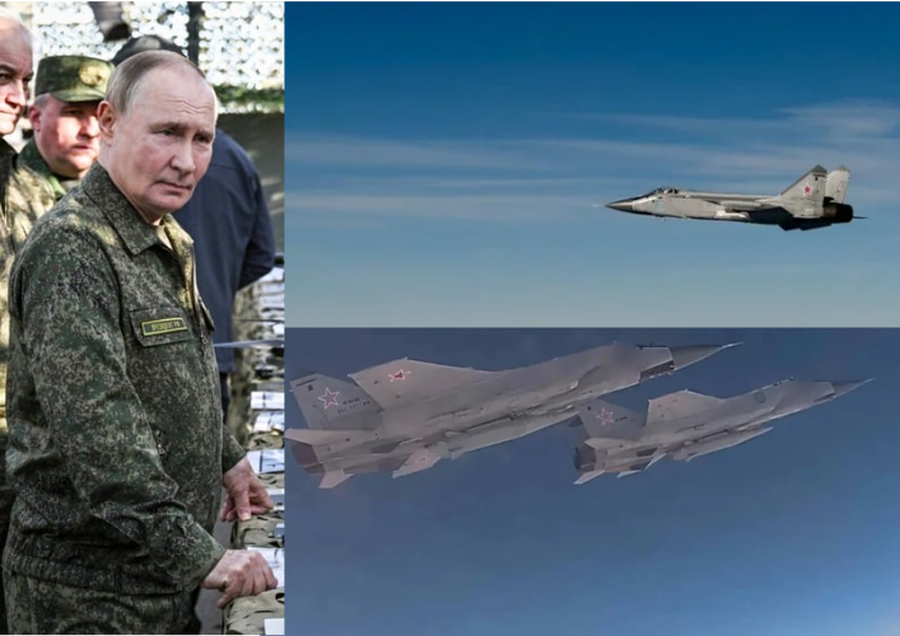
Russia is escalating its military pressure on NATO's eastern axis. On Friday, three Russian MiG-31 fighter jets violated Estonian airspace for 12 minutes near the island of Vaindloo in the Baltic Sea. The incident came days after 20 Russian drones were spotted in Poland, amid rising tensions between Moscow and the Europeans.
Serious violation with political consequences
In its analysis, Le Monde notes that according to the Estonian Ministry of Defense, the fighter jets flew without a flight plan, with transponders turned off and without communication with the Tallinn control tower. Estonia, which does not have its own air force, relies exclusively on NATO air policing. In Friday's episode, Italian F-35 jets participating in NATO's Baltic Air Policing mission immediately took off to intercept.
Foreign Minister Markus Tsachkna denounced this as the fifth violation by Russian aircraft in 2025. "We must respond with stricter border controls and political and economic pressure on Russia," he said.
Concerns about NATO's weaknesses
The alliance called the incident "a new example of dangerous Russian behavior."
At the same time, military analysts recall that Russian aircraft flights in the region are frequent due to the narrow airspace between St. Petersburg and Kaliningrad. However, lack of professionalism or deliberate provocation creates uncertainty and increases the risk of an accident or escalation.
Estonia and Poland have already requested an emergency meeting under Article 4 of the NATO Treaty, which provides for consultations in the event of a threat to a member state.
The request reflects the Baltic countries' concern about the Alliance's operational capabilities in the field of air defense, where needs are growing but resources remain limited.
Military exercises by both sides
The incident coincided with large-scale exercises. Russia concluded its four-year "Zapad" exercise in Belarus on September 16, involving 15,000 troops, simulating the use of tactical nuclear weapons and the presence of troops from Iran, Mali, Burkina Faso and, for the first time, a small Indian detachment.
India's participation was considered highly symbolic, as it had hitherto maintained a neutral stance towards the war.
At the same time, NATO is preparing for the "Neptune Strike" exercise in the Baltic and North Seas, with the participation of Scandinavian and German naval forces and the presence of the American aircraft carrier USS Gerald Ford.
Escalation with unknown purpose
Moscow denied the violation, claiming there was no entry into Estonian airspace. Despite Russian denials, tension remains.
Experts believe that such incidents act as a message of strength and a test of resilience to NATO, at a time when Ukraine is still at the epicenter of the war.
Estonia and the other Baltic countries, without strong air defenses of their own, are seeking greater involvement from allies, considering that Russia's movements are not limited to Ukraine, but aim at the security of Eastern Europe as a whole. / Adapted from Le Monde






Lini një Përgjigje