


 Shkruar nga Georgi Gotev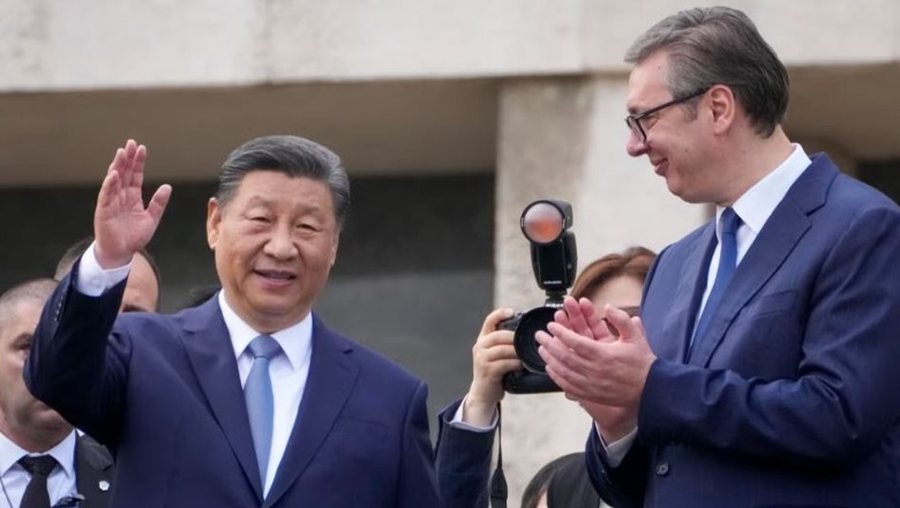
Soon China will see itself as the number one power in the world. But until then she will be patient. Meanwhile, it has geopolitical ambitions in the EU, as in all other parts of the world.
The President of China, Xi Jinping, has recently been welcomed as the Messiah (savior of the world) in Serbia and Hungary. The scenes that were seen on television were reminiscent of the communist era. Belgrade and Budapest were decorated with many flags and posters and citizens traveled from all over in buses to gather in the square and greet the famous visitor.
Seen from Brussels, it is not a little disturbing that Serbia, a candidate country for the European Union, says that it agrees to a "shared future" with communist China. While Hungary, a member of the EU for 20 years, wants to use Beijing's visit as a counterweight to the "pressure coming from the union".
Of course, the issue of Chinese investment may seem like a vital aid to two countries that are currently experiencing economic difficulties. But there is also something else. China is a communist country and a major geopolitical player. But today it also represents, better than any other country, state capitalism.
On the other hand, the European Union, a more modest player in global geopolitics, represents, better than others, liberal capitalism based on clear rules and regulations. In liberal capitalism, you can succeed if you are smarter, faster, more innovative, and if you follow the rules.
Whereas in state capitalism, like that in China, you can only succeed if you are in power or if you obey those in power. Unlike liberal capitalism, state capitalism is a system in which those in power do not change.
This is precisely what makes the Chinese system attractive to Viktor Orban, in power since 2010, and to Aleksandar Vucic, leading Serbia since 2014 as prime minister and since 2017 as president. After so many years in power, both are beginning to feel the pressure of opposition from public opinion.
In China, dissent has become almost impossible. Facial recognition cameras follow every movement of citizens. Even crossing the road with a red light is documented by the authorities and the state notices every time a citizen breaks a rule. Payments are made only through smartphones and in this way the state knows how much beer or cigarettes a citizen drinks.
Such data create the possibility of evaluating citizens, show who is at work, who has received loans and who has not, etc. Even Serbia has begun to put into operation the system of Chinese mass surveillance cameras. MEPs have long spoken out against this Orwellian innovation, but this development has largely gone unnoticed or has been left entirely in the shadows.
Soon China will see itself as the number one power in the world. But until then she will be patient. Meanwhile, it has geopolitical ambitions in the EU, as in all other parts of the world. And this is not just about building a railway, as with the Chinese project to connect the Greek port of Piraeus (which was sold to China because the EU was stupid enough to force Greece to sell its most valuable assets mira) with Belgrade and Budapest.
But it's all about more than transport infrastructure. Through Serbia and Hungary, China is introducing its political infrastructure to the EU. Beijing is supporting this example, which is expanding. Ambitious European leaders, who have come to power under nationalist slogans, would like to cement their power.
The first example that comes to mind is the new leadership of North Macedonia, a country that lies along this railway line. Before Brussels wakes up from its slumber and faces reality, EU members Slovakia and Bulgaria, as well as Bosnia and Herzegovina and Montenegro, EU members Bosnia and Herzegovina and Montenegro can join China's projects.
It is unfortunate that such a comment comes after May 9, a special day for Europe. Even more so, since the campaign for the European Parliament elections has just started. In Brussels, some humorously call May 9 "La Saint Schuman" (Saint Schuman) after Robert Schuman, author of the historic declaration, which presented his idea for a new form of political cooperation in Europe, which would make unimaginable war between the nations of Europe.
If today we have two wars on the brink of the continent, this does not mean that Schuman was wrong. On the other hand, the current political cooperation in Europe is not at the level it should be./ Adapted from: "Pamphlet" , Taken from: "Euractiv"



Lini një Përgjigje