


 Shkruar nga Pamfleti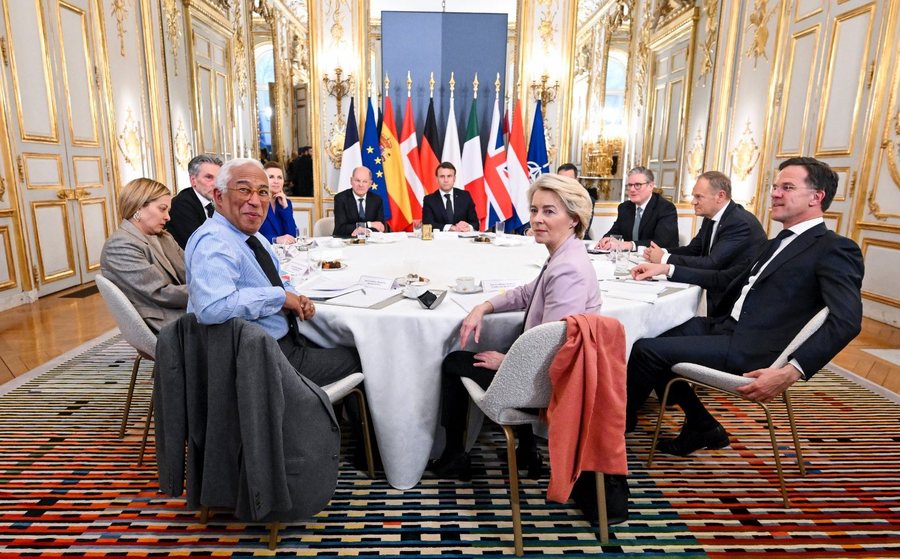
Thursday's meeting has been dramatically reshaped in recent days...
An EU summit, once seen as a chance to boost the bloc's economy, is now a full-blown stress test. Leaders meeting on Thursday face a heated agenda: Ukraine's financial survival, escalation in the Middle East, transatlantic tensions and deep internal divisions over energy and climate policies.
Thursday's meeting has been dramatically reshaped in recent days by the US-Israeli war on Iran and a standoff with Hungary over a 90 billion euro bailout plan for Kiev, turning what was meant to be a visionary discussion into an attempt to manage multiple crises at once.
Leaders will still try to push forward plans to strengthen Europe’s competitiveness, from deepening the single market to easing the burden on businesses. But those long-term ambitions risk being overshadowed by more immediate geopolitical conflagrations, along with intense discussions on the continent’s energy, defense and migration policies, according to a draft version of the post-summit joint statement obtained by POLITICO.
1. The 90 billion euro question: Hungary against everyone
A €90 billion bailout for Ukraine, which will determine Kiev’s ability to continue defending itself against Russian aggression, hinges on whether Hungary lifts its veto. EU leaders agreed in December to provide the funds. But Hungarian Prime Minister Viktor Orbán later reneged on and blocked the deal over a dispute with Ukraine over a damaged pipeline carrying Russian oil to Central Europe.
Budapest has accused Kiev of trying to create an energy crisis in Hungary by cutting off Russian oil supplies and says it will not approve the disbursement of money until flows resume. The European Commission said on Tuesday it had offered to help repair the pipeline and that Ukraine had accepted, raising hopes for a breakthrough.
The move could prompt Hungary to lift its veto, said a diplomat familiar with Budapest’s thinking, speaking on condition of anonymity like others in this article to discuss the delicate negotiations. But Orbán struck a defiant tone in a video posted after the Commission’s announcement, saying: “If there is no oil, there is no money.” That leaves him isolated from almost all other leaders except Slovakia’s Robert Fico. The latest draft still points to the disbursement of the loan by early April, a deadline that leaders will try to salvage in their negotiations.
2. The Hormuz Dilemma: Iran's Threats to a Reluctant Europe
Tehran's attacks on ships in the Strait of Hormuz, a vital transit point for oil, have pushed up global oil prices and forced Europe to weigh whether to get involved. One idea was to expand the mandate of the EU's naval mission in the Middle East, Aspides, to allow European warships to patrol the waterway. That was quickly ruled out by the bloc's foreign ministers on Monday.
“Nobody wants to be actively involved in this war,” the EU’s top diplomat, Kaja Kallas, said after the foreign envoys met. Instead, leaders will call for reinforcing existing naval missions, Aspides and Atalanta, with “more assets,” while not extending their reach to Hormuz, according to the summit’s draft conclusions. The text emphasizes that the operations must remain in line with their respective mandates. A diplomat from the Gulf region said they were watching closely but did not expect any major changes from EU leaders, such as extending Aspides’ mandate or launching joint operations with third countries.
3. Transatlantic tremors: Trump against European capitals
Europe’s refusal to intervene in the Strait of Hormuz has angered US President Donald Trump, who said it would be “very bad for the future of NATO” if EU countries did not act. That frustration is only growing. Republican Senator Lindsey Graham said he had spoken to Trump about Europe’s unwillingness to provide assets to keep the strait open and that he had “never heard him so angry in his life.”
The escalation comes at a time when EU-US relations are already strained. Spain has openly defied Trump over the conflict with Iran, refusing to allow the US to use its bases and facing trade retaliation from Washington. French President Emmanuel Macron has stepped in to support Madrid and signal European solidarity, while other leaders have taken a more cautious or mixed stance on how far to respond. Trump may not be on the official agenda, but his pressure will dominate the summit - and exacerbate already tense debates over defence, trade and Europe's dependence on the US.
4. ETS case: Italy, Poland and others against the Commission
A major row is brewing over the EU Emissions Trading System between a group of member states and the EU executive. Ten EU member states sent a letter to the Commission ahead of Thursday's summit, demanding the acceleration of a planned review of the ETS, a cornerstone of the bloc's climate policy that forces big polluters to pay.
Poland, the Czech Republic, Slovakia, Romania, Greece, Hungary, Italy, Bulgaria, Austria and Croatia are asking the EU executive to review the scheme no later than the end of May, arguing that it is harming their industries and contributing to rising energy prices.
But not everyone agrees, with two EU officials from ETS-backing countries saying the cap-and-trade system should remain in place. The first official argued that it is not contributing to the energy crisis and is actually helping Europe’s economy, with revenue needed for the green transition. On the energy front, lower gas prices are also likely, although not all countries will agree to this, according to a senior German government official. According to the draft conclusions, EU leaders will instruct the Commission to “present without delay a set of temporary targeted measures” to lower energy prices.
5. Competitiveness, the EU versus itself
Despite the crises topping the agenda, leaders will still try to push ahead with plans to revive Europe’s economy, building on talks at a February summit in Alden Biesen, Belgium. Most of the proposals run counter to the “One Europe, One Market” push to deepen the single market, easing the movement of goods, services, capital and people across the bloc. The draft conclusions say leaders will back new corporate rules, dubbed “EU Inc.”, to help startups expand across borders, as well as a “simple, unified and voluntary electronic declaration system” to make it easier to do business across countries.
The aim is to move from talks to implementation, with concrete steps and deadlines, another EU diplomat said. But while there is broad agreement on the need for reform, divisions persist over whether the EU’s energy and climate policies — particularly the Emissions Trading System — are hindering growth. This divide, with countries in central, eastern and southern Europe pushing for change and others, including the Nordic countries, resisting, is likely to be a key battleground for competitiveness./ Adapted from “Pamphlet” by “Politico”


Lini një Përgjigje