


 Shkruar nga Dritan Haxhiraj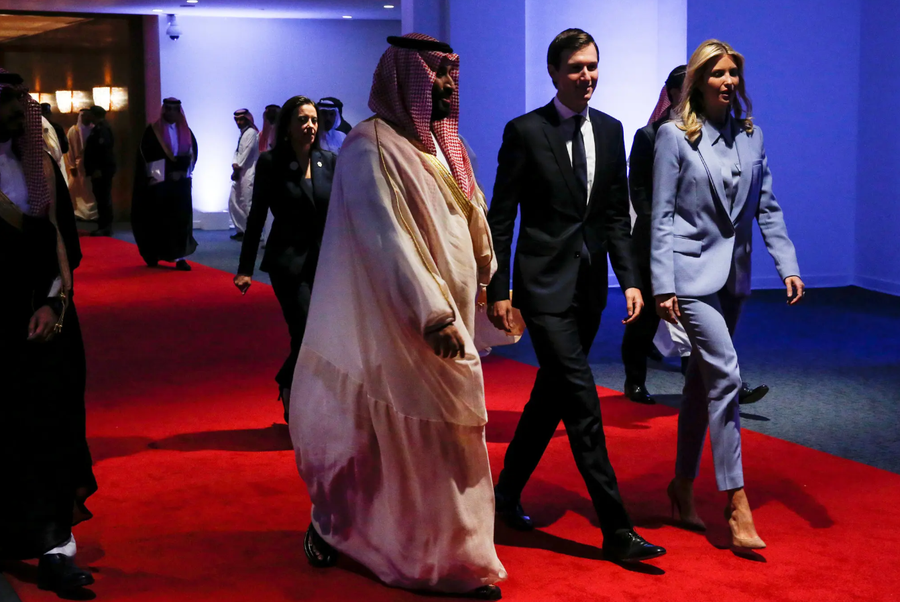
Donald Trump, an open alliance with pro-autocratic regimes that offered the US stability and business.
An unprecedented visit
It was Donald Trump's first visit outside the United States as President. But unlike any of his predecessors, Trump didn't choose to debut in Canada, the United Kingdom, or NATO headquarters in Brussels. No. He chose Saudi Arabia.
Since Air Force One landed in Riyadh on May 20, 2017, the ceremony was spectacular: King Salman himself welcomed him at the airport, an honor that even Barack Obama was denied two years earlier. On every street in the capital, posters with the faces of Trump and the Saudi king. The message is clear: this is the new partnership.
Kushner, bridge to the new era
But the silent but decisive actor in this chapter was not Trump. It was Jared Kushner, his son-in-law, an Orthodox Jew with billionaire roots in real estate. Kushner was the real negotiator of the deals with Saudi Arabia, especially for massive arms contracts worth over $110 billion.
He brokered the price reduction for Black Hawk helicopters, called the head of Lockheed Martin directly, and secured the “last” discount for the Saudis. All while the Saudi delegation waited in the next room.
Kushner's relationship with Crown Prince Mohammed bin Salman (MbS), then a 33-year-old on a free-fall ascent to absolute power, turned into a strategic friendship that would influence global diplomacy for years.
Alliance over oblivion and the common enemy: Iran
Trump and King Salman agreed on one thing: Iran as a common enemy. That was enough for Saudi Arabia to forget that just a few months earlier Trump had blamed it for 9/11 and demanded “free oil for ten years.”
In exchange for arms and promises of aid against Iran, the Saudis forgot all insults and agreed to launch a “Global Center for Countering Extremism.” Ironic, since it is Saudi Arabia that has funded the world’s most radical madrassas for decades.
Trump didn't apologize to Islam: he gave it weapons
Trump's speech in Riyadh was strong: no apologies, no talk of human rights, no concern for Yemen. There was only one message: "Join us against terrorism. This is the era of stability, not intervention."
Opposite him were the leaders of the GCC, the six wealthy Gulf states, excluding Iran. They all expected a "conference on Islam" like the one Obama had held at Cairo University in 2009. Instead, they heard an open alliance of pro-autocratic regimes offering the US stability and business.
From "America First" to "Arms First"
The $110 billion contract included warships, missile defense systems, tanks, and over 150 Black Hawk helicopters, cornerstones of the American military-industrial complex. All of this came with a guarantee that there would be no more voices raised about women, human rights, mass incarceration, or atrocities in Yemen.
Trump made it clear: “I didn’t come to tell you how to live. That’s your job. We’re here for partnership and stability.”
A silent but profound geopolitical shift
In retrospect, May 20, 2017, was much more than a presidential visit. It was the turning point that heralded America's distancing itself from Obama's moral politics and reconnecting with classic realpolitik: weapons, stability, shared interests.
It was also the moment when Saudi Arabia chose to trust the son-in-law of the American president more than any diplomat or senator in Washington./ Pamphlet



Lini një Përgjigje