


 Shkruar nga Pamfleti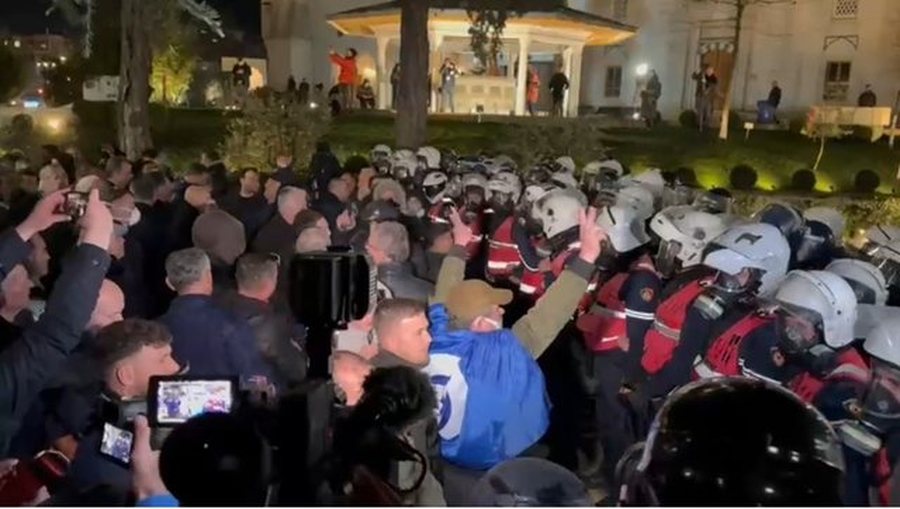
One scenario that has been discussed in recent weeks is the isolation of the opposition or a group of 10-15 lawmakers in the Assembly, although this seems an extreme form, which has so far not been accepted by the Democratic Party leader, Sali Berisha...
The Democratic Party will hold another protest, this time in front of Parliament, while the session will discuss SPAK's request for the immunity of Belinda Balluku, former Deputy Prime Minister and former Minister of Infrastructure, who is being investigated by the Special Prosecution for violations of equality in tenders.
The protest will start at 10:00, while Sali Berisha has called on the citizens of Tirana to gather in front of Parliament. A day earlier, when Edi Rama's socialists decided not to accept SPAK's request, Berisha declared that it is now up to the sovereign to speak.
March 12 is a big day. On March 12, all Albanians in front of the parliament. March 12 is the day of the spring of democracy, the day of the great overthrow of the drug regime. So at 10:00, all of Albania in the parliament. Let us give the deserved answer to Edvin Kristaq Rama and his gang", said Berisha.
This is not the first time, and probably won't be the last, that Berisha has used the same threats and warnings towards what he considers to be Edi Rama's regime, although after every protest, it seems that an even more arrogant Prime Minister appears, increasing the doses of ridicule and humor towards the opposition.
But what is expected to happen in the March 12 protest, which Berisha described as the spring of democracy for Albanians?
DP supporters are expected to position themselves at both entrances to the Parliament, the one from 'George W. Bush' Street and the one from 'Pedonalja'. The aim will not be to prevent MPs from entering the session, also due to the fact that legislators, especially those from the SP, are expected to be in the Parliament hall at the time the protest is announced, to start with the agenda.
It is not known whether the Democratic MPs will be instructed to obstruct the normal development of the plenary session, but some of them will occasionally join the protesters to deliver messages. One scenario that has been discussed in recent weeks is the isolation of the opposition or a group of 10-15 lawmakers in the Assembly, although this seems an extreme form, which has so far not been accepted by the Democratic leader, Sali Berisha.
The chosen form of protest in front of Parliament is the same as those previously used by Lulzim Basha, when he gathered supporters in front of the Assembly. At least two of the MPs expelled from plenary sessions, Gazment Bardhi and Klevis Balliu, are expected to be among the protesters, while other lawmakers will appear both in the hall and at the protest to deliver messages.
Although there is no timetable for how long the protest may last, the DP headquarters says that opposition supporters will stay for extended hours, as long as the Parliament's proceedings will last. This means that there may be tensions and clashes, although this time there will be no Molotov cocktails or fireworks, which have become a common tool in recent opposition protests. And perhaps the most decisive moments will be those of the exit of the socialist deputies from the Parliament hall, although it is planned that they will pass, as has happened before, through the passages that connect the Parliament building with the Academy of Sciences.
As in previous protests, a large commitment of police forces is expected, who will be stationed at the entrances to the Parliament, in support of the Guard structures, which are tasked with securing the internal territory of the Parliament.
This means that police forces will be concentrated on the outer perimeter, just as has happened in previous opposition protests, starting at the Prime Minister's Office and ending at the Parliament. Iron barriers are also expected to be installed as a preventive measure to avoid trump-on-trump clashes between police and protesters.
Reports indicate that up to 500 police forces may be deployed in the March 12 protest, almost 1/3 of those deployed in the recent protests called by the opposition. But some of the law enforcement forces will also be stationed near the Prime Minister's Office, to prevent situations that could get out of control. /Pamphlet/





Lini një Përgjigje