


 Shkruar nga Pamfleti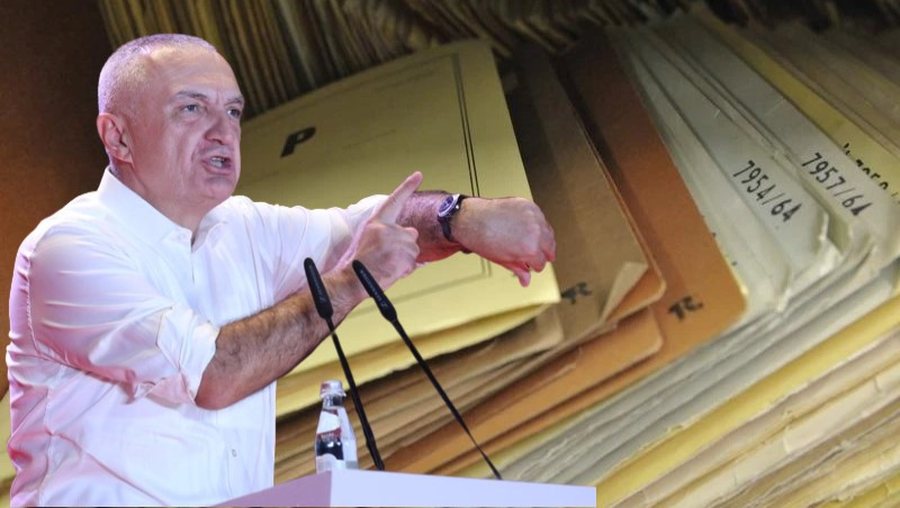
Three years after legal changes, declassification is hampered by new procedures and institutional clashes...
After the release of data that then-president Ilir Meta was connected to the former State Security, the SP and DP enthusiastically approved several legal changes in 2022 and 2023, with the promise that all Sigurimi documents would be opened and all officials connected to it would be exposed.
But even though three years have passed, there is still no real transparency for the public. On the contrary, the latest data shows that the process has not only not advanced as promised, but has faced serious obstacles and in some cases has reached an impasse.
This is also confirmed by the 2025 report of the Authority for Information on Former State Security Documents (AIDSSH), which clearly highlights the problems that have accompanied the declassification process over the last year.
Laws passed in 2022 and 2023 stipulate the declassification of all documents of the former State Security for the period from November 29, 1944 to July 2, 1991, which should be considered declassified, with the exception of those related to national security or international relations.
However, in practice the situation has taken a different turn. A decision of the Council of Ministers adopted in December 2024 has brought a number of complications to the process. This by-law provides for additional procedures for cases where the institutions that produced the documents no longer exist, requiring the involvement of other institutions or representatives of similar fields in the assessment process.
According to AIDSSH, this has created a new bureaucratic chain, which has significantly slowed down the declassification process. In many cases, the opinion of the State Intelligence Service (SHISH) is also required for each document, which leads to significant delays. Although not every document poses a risk to national security, the same procedure is widely applied, making the process long and slow.
The Authority itself admits that this situation has led to a partial blockage of the mass declassification, forcing the institution to take steps to review internal acts and to request intervention from the Parliament and the Council of Ministers. In November 2025, AIDSSH addressed the Parliament for the harmonization of existing laws, while in February 2026 it requested a review of the government decision that created the obstacles. But it seems that the government has blocked the process.
Meanwhile, another part of the report is related to the process of verification of figures, which has continued in parallel. During 2025, 128 requests were submitted for the verification of 253 candidates for public positions or various functions. Of these, 242 people were verified and only 15 of them resulted in data in the documents of the former State Security, as collaborators or involved in processes of the time.
In total, over 22 thousand pages of archival documents have been reviewed, which indicates a large volume of work on the part of the institution. However, this process remains limited to the function of institutional verifications and does not translate into a broad and transparent opening of the files to the public.
In this context, the promise made to fully open the files and confront the past remains unfulfilled. Legal conflicts, complicated procedures and the lack of clear institutional coordination have caused one of the most important processes for the country's historical transparency to remain on hold. /Pamphlet




Lini një Përgjigje