


 Shkruar nga Pamfleti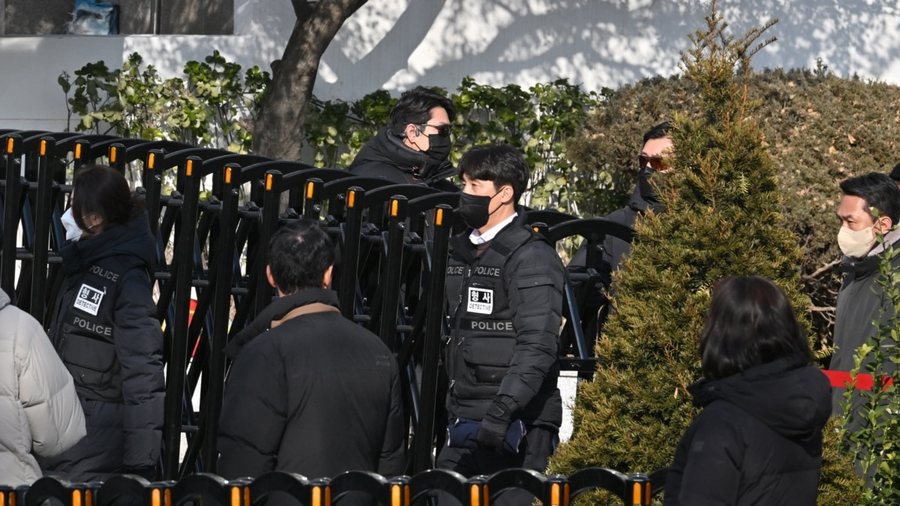
South Korean authorities said Friday they suspended efforts to arrest President Yoon Suk Yeol, who was previously dismissed by parliament, after a tense standoff that lasted about six hours between authorities and security forces loyal to the president.
The joint law enforcement team trying to arrest President Yoon said in a statement that it was "practically impossible" to proceed with the court-confirmed arrest warrant, given the resistance and security for the forces. of order, at the scene.
About 100 investigators and detectives, backed by 3,000 crowd-management police stationed outside the presidential residence in central Seoul, went to arrest President Yoon in the early hours of the morning. The operation was part of the investigation of the president under charges of rebellion and abuse of office.
After several small skirmishes around the compound, the arrest team approached within 200 meters of Mr. Yoon's residence, but encountered a barricade of 200 soldiers and armed security personnel that prevented investigators from entering the residence. according to the Office for Corruption Investigation, which is leading this joint investigation.
Although none of the security personnel protecting Mr. Yoon drew their weapons, the Corruption Investigation Bureau referred to "apparent danger" due to the presence of a large number of people inside an enclosed space.
The joint investigative team said it will consider next steps on the warrant, which expires Monday.
Friday's events followed a tumultuous political month that began on December 3, when President Yoon, a former conservative prosecutor, declared a state of emergency. The state of emergency was quickly overturned by lawmakers, who later voted to impeach Mr. Yoon and suspend his presidential powers and duties, but the final decision on whether to impeach him is now in the hands of the country's Constitutional Court.
In addition, Mr. Yoon is being investigated for rebellion and abuse of office related to the declaration of a state of emergency.
Mr. Yoon ignored three requests to appear before authorities for interviews as part of the investigation, prompting a Seoul court to issue an arrest warrant for him earlier this week.
The Presidential Security Service, which provides protection to Mr. Yoon, has repeatedly blocked investigators from entering the presidential office or official residence for court-authorized raids, citing security and military reasons. During Friday's operation, the service was joined by a military unit believed to be part of the Capital Defense Command, according to the Korean news agency Yonhap. According to the Ministry of National Defense, the members of this military unit are under the command of the Presidential Security Service, not the army.
Prosecutors warned that any attempt to obstruct the execution of the court-approved arrest warrant would constitute a criminal offence, although there were no signs that police had attempted to arrest members of the units protecting Mr. Yoon on Friday.
Mr. Yoon's legal team says the investigation into the sedition charges is illegal. This team insists that the Office for Corruption Investigation has no mandate to investigate such allegations.
Mr Yoon's lawyers said in a statement on Friday that the attempt to enforce the warrant is illegal and vowed to seek legal action to block it.
If Mr. Yoon were to be detained, the authorities would have 48 hours to decide whether to seek his detention or release him. This would be the first time a sitting president in South Korea has been detained by police.
Meanwhile, a crowd of Mr. Yoon's supporters gathered outside his residence. Some of them vowed to defend him and called for the arrest of opposition leaders. / VOA





Lini një Përgjigje