


 Shkruar nga Pamfleti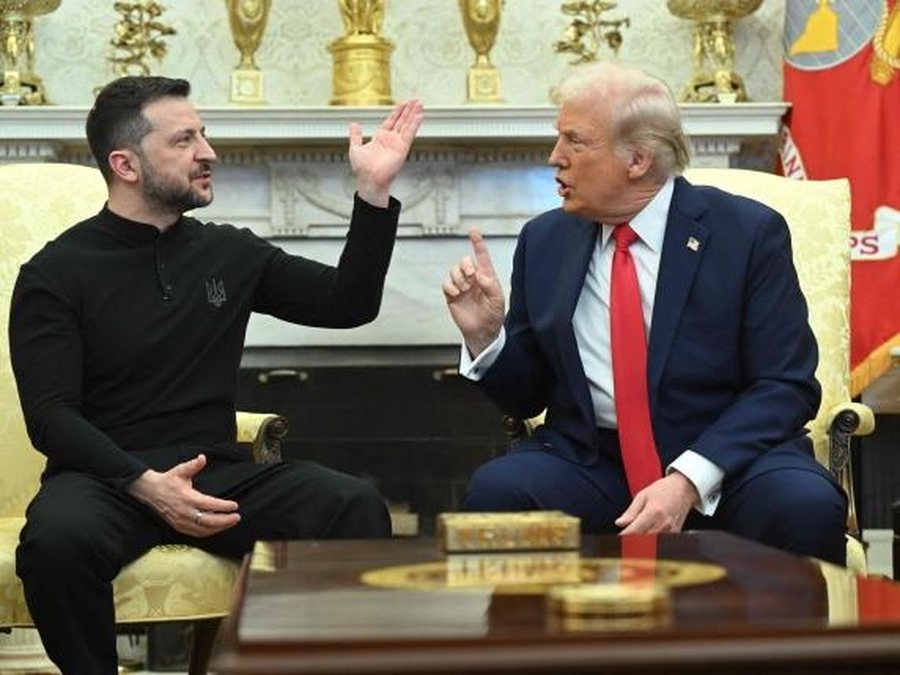
The toxic relationship between Donald Trump and Volodymyr Zelensky is an increasingly visible part of the Ukraine crisis. The two leaders, for better or worse, have known each other for six years. But they have never really been on the same wavelength.
April 26, at St. Peter's Basilica where Pope Francis' funeral was being held, had left everyone somewhat bewildered.
For the first time, the American president seemed willing to listen to the Ukrainian's arguments and, above all, act accordingly.
But now, after nearly four months, those two chairs so close together, those moments of political intimacy, have disappeared with Trump's latest statement, "I don't like what Zelensky is doing."
Words that take us back to February 28 of this year: in the Oval Office, Trump and his vice president, JD Vance, mistreated the guest who had come from Kiev to request weapons, funds, and long-term military protection.
We dare not delve into the psychological mechanisms that may be activated every time the two meet in person or talk on the phone.
However, there is one constant that has marked their relationship from the beginning: Donald Trump demands things that Volodymyr cannot give.
The story begins in September 2019.
Trump is nearing the end of his first term and sees Joe Biden's candidacy taking shape in the opposing camp. Together with his fearless advisor, former New York Mayor Rudy Giuliani, they begin to pressure Zelensky to force the Ukrainian judiciary to reopen the investigation into Hunter Biden, Joe's son, who claims he was involved in corruption.
At the time, Hunter was on the board of Burisma, a major Ukrainian gas company. This was certainly an anomaly, given that he had no expertise in energy matters. But there was no evidence against him that he had committed any crime.
Zelensky had just won the election on a platform of fighting corruption and strengthening democratic institutions. He had absolutely no inclination to please Trump, who, in response, suspended $250 million in military aid for months.
Zelensky tried to explain this to him during their first bilateral meeting, in New York, on September 26, 2019. The former comedian appeared in a suit and tie. Beardless, confident. At times brilliant. Trump showered him with compliments and said, “I hope you and Putin find a solution to your problems.”
We know how it went: the Russian invasion of February 24, 2022; the Ukrainian resistance and, on January 21, 2025, Trump's return to the White House.
The basic model, however, has not changed. The American president “deals the cards” because he believes he is the only one who deals with them. One could argue that between the United States and Ukraine, things could not have gone any differently. However, with Biden as president, things were different. The White House team began to listen to Zelensky’s demands and then decide how many of them to follow.
Now, what the Ukrainian president thinks or hopes doesn't matter (almost) at all. Trump wants to decide for himself. He doesn't always succeed, but that's the guiding principle. Today, the disagreement is over substance.
The US president is convinced he has found the formula to end the war. Kiev would have to give up 20% of its territory, currently in Russian hands. At that point, Trump is confident he can even push Vladimir Putin to agree.
Zelensky cannot consent to the brutal mutilation of the country. And he certainly will not do so unless he receives the necessary guarantees from the United States to prevent future attacks from Moscow. This is not a new issue.
Biden’s advisers were also convinced that Kiev would eventually be forced to give up most of the occupied territory. At the same time, however, Biden had offered Zelensky “an irreversible path to NATO.”
Trump has given up on everything; he wants to end the situation as soon as possible and considers the Ukrainian leader's insistence an obstacle. He thinks so and says it out loud./ Corriere della Sera




Lini një Përgjigje