


 Shkruar nga Pamfleti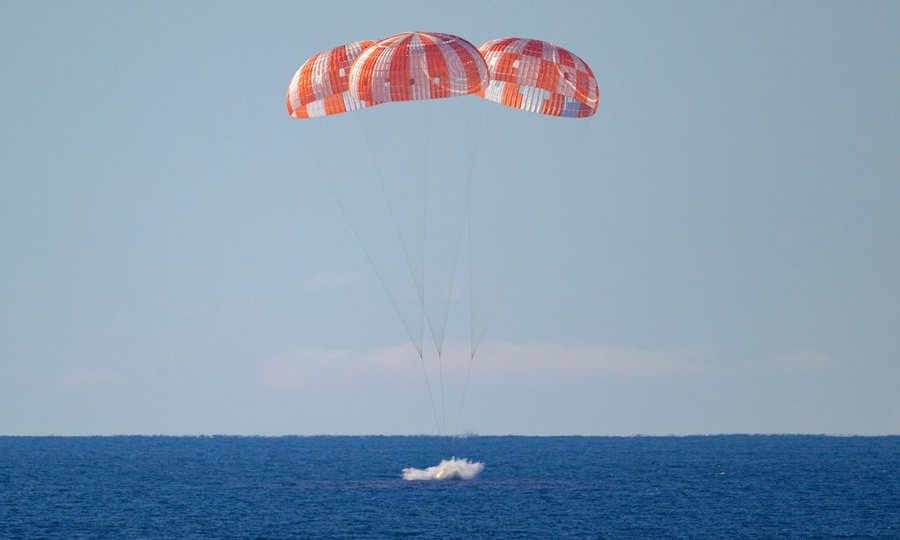
For six minutes, NASA in Houston and the entire world did not know the fate of four astronauts, Reid Wiseman, Victor Glover, Christina Koch and Jeremy Hansen, in one of the most critical phases of any crewed spaceflight: reentry into the atmosphere.
The Orion capsule separated from the European spacecraft and activated its heat shield. The crew was preparing for re-entry into the atmosphere and landing on Earth at a speed of 40,000 km/h.
At this speed, the astronauts passed through the layers of the atmosphere and Orion's protection withstood temperatures reaching 2700 ºC. The astronauts confirmed via radio that they were safe inside the capsule as they descended by parachute.
Planned six-minute outage
During the six minutes without communication, the capsule descended through the atmosphere like a projectile. The deceleration was instantaneous: from 40,000 km/h to a speed suitable for a safe landing on water. The heat generated by friction reached 2,670 ℃, turning Orion into a blazing torch in the Pacific sky. The astronauts endured this segment without communication with Earth, focused on monitoring internal systems, ready to react to any malfunction.
At an altitude of 8,077 meters above the ocean, the capsule reduced its speed to 523 km/h thanks to atmospheric braking. At this point, the systems for the gradual opening of the parachutes were activated.
First, three parachutes from the front compartment cover, with a diameter of 2.1 meters. Then, two braking parachutes of 7 meters and, finally, at 2,896 meters, three main parachutes with a diameter of 35.3 meters and a weight of 140 kilograms each.
This system slows the capsule to a speed of less than 32 km/h, which is the optimal speed for a controlled landing in the water.
NASA had described this last segment as the "six-minute planned blackout period," a window of complete silence that began when Orion entered the densest layers of the atmosphere at an altitude of 400,000 feet.
The capsule fell at a speed that allowed it to travel the distance from New York to Tokyo in less than 20 minutes. The goal was to land on the coast of San Diego, California, completing a journey of 1,118,624 kilometers in space.
The main challenge was the integrity of the heat shield, a titanium structure coated with 186 Avcoat layers, reaching a thickness of 3.8 centimeters. This protection has been the subject of special attention since the Artemis I reentry, when NASA identified damage due to Avcoat breakage in the uncrewed capsule during its descent in 2022.
During reentry, Orion endured temperatures of 2,760 degrees Celsius, more than twice the temperature of volcanic lava and almost half the temperature of the surface of the Sun. Atmospheric friction and compression create a glowing plasma bubble surrounding the capsule, completely blocking radio communications.
Astronauts perceive this moment as a journey through “a ball of fire in the atmosphere,” as described by Victor Glover, who admitted that the return “was on his mind since the day he was selected.”
NASA and the Canadian Space Agency (CSA) coordinated training for this segment with extraordinary rigor. The crew reviewed procedures and ran simulations for any potential failures.
That's how the crew of the Artemis II mission was rescued. Están todos bien , increíble ???????? pic.twitter.com/C3EOAHxCm9
— China (@chinitaliberal) April 11, 2026








Lini një Përgjigje