


 Shkruar nga Pamfleti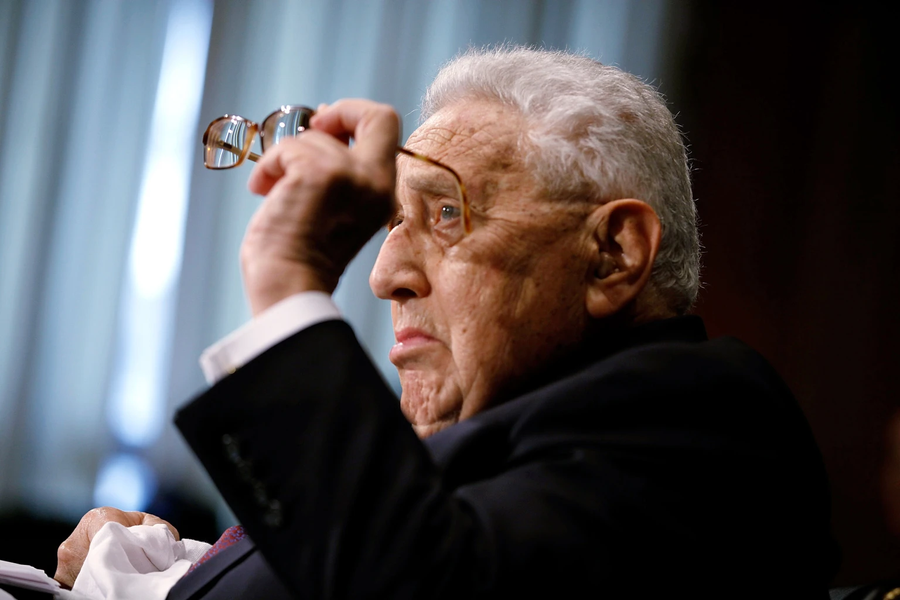
Whatever one thinks of him, Kissinger has led an extraordinary life.
Stephen M. Walt writes, Foreign Policy
Former US Secretary of State Henry Kissinger has celebrated his 100th birthday several times over the past month, including a private party at the Economic Club of New York and the Public Library attended by dozens of A-list VIPs. .
The spectacle is eloquent evidence of Kissinger's unique status. Few statesmen have received the same treatment while alive – not even some former presidents.
Whatever one thinks of him, Kissinger has led an extraordinary life.
He is a refugee from Nazi Germany who eventually rose to the heights of power in the United States and who has remained a major influence on US foreign policy for nearly seven decades.
After a century on the planet, his admirers now hail him as the greatest strategic thinker the United States has ever produced.
His name adorns scholarships at the Council on Foreign Relations, the Library of Congress, chairs and research centers at several universities.
One cannot think of anyone who still has the same level of public attention in their 101st year.
Yet there is a conundrum at the heart of Kissinger's extraordinary life.
Although he is now routinely hailed as a foreign policy thinker, his long career is not as impressive as his admirers think.
He is clearly a man of extraordinary intelligence and achievement – something even his harshest critics would admit – but the question is whether the reputation he has earned a century later is fully deserved.
This is the "Kisinger conundrum".
Given his overall record, why is Kissinger now viewed with a sense of awe and treated as if his grasp of world affairs surpasses all others?
To understand this puzzle, it is helpful to divide Kissinger's professional career into three sections.
The first phase is his academic career at Harvard, where he taught from 1954 to 1969.
The second stage is his government service.
Special assistant to President Richard Nixon on national security matters and later as secretary of state and national security adviser to Nixon and Nixon's successor, Gerald Ford.
The third phase—the much longer—is his career as an author and pundit, most of which was spent as head of Kissinger Associates, the consulting firm he founded after leaving government.
During the first phase – as an academic at Harvard – Kissinger published several books and many articles and began his long association with Nelson Rockefeller and the Council on Foreign Relations.
Although some of his books received widespread attention, ultimately his contributions to scholarship in this period were not significant.
None of his early works deserve the label of a classic, and few of them are widely read or discussed by scholars today.
Kissinger also wrote a lot about nuclear weapons, but not with great influence.
Of course, Kissinger could have had a greater impact on the world of scholarship if he had chosen to focus his energies there.
We now know that he intended to write a trilogy on world order that would continue the story he had begun.
The two subsequent volumes would have dealt first with the Bismarckian order of the late 19th century and then with the breakdown of that system in the First World War.
However, Kissinger was increasingly preoccupied with matters of real-world politics, and the trilogy was never completed.
And it was these activities—including a deep dive into U.S. policy in Vietnam—that eventually brought him into government in 1968.
But the fact remains: Judged simply as a scholar, Kissinger is not a member of the pantheon.
Kissinger's record as national security adviser and secretary of state is and always will be controversial.
He has some notable achievements, including opening up to China, negotiating important arms control agreements with the Soviet Union and, to some observers, his handling of recurring Arab-Israeli conflicts.
But these achievements must be balanced against his support for the war in Vietnam and his direct role in prolonging it – despite his awareness that the war could not be won.
Nixon and Kissinger also chose to expand the war into Cambodia, inadvertently opening the door to the genocidal rule of the Khmer Rouge.
Kissinger's support for August Pinochet's coup in Chile and his handling of the Indo-Pakistani war of 1971 also deserve harsh criticism.
This brings us to the third phase: Kissinger's long career providing strategic advice to corporations, governments, and the public at large through a dizzying array of activities, a stack of weighty books, newspaper columns, and other forms of outreach.
How does his story flow in his long post-government career?
Not bad, but not as good as you might think.
To begin with, Kissinger has published many books since leaving the government, but apart from his three volumes of memoirs none of them are space trail or particularly significant contributions to scholarship.
What about his other activities?
As Matt Duss recently noted, Kissinger largely invented—and certainly perfected—the art of turning government service into a lucrative post-government career.
Kissinger Associates became the model for a cottage industry of firms (Cohen Group; Albright Stonebridge Group; Rice, Hadley, etc.)
The days when a public servant like George Marshall would turn down lucrative offers to cash in on his career because he thought it improper to profit from public service (and the sacrifices of others) are long gone, and Kissinger did the same as much as anyone to erode that morale.
The potential for conflict of interest is obvious, especially when these former officials remain active in public discussions of foreign policy and in some cases return to government.
Moreover, Kissinger took on some of the biggest strategic questions we've faced since he badly left office.
He was an early supporter of NATO expansion.
Kissinger also supported the 2003 invasion of Iraq – arguably one of the biggest strategic blunders in US history – and opposed the 2015 nuclear deal with Iran.
And he failed to foresee that helping China rise through a policy of engagement would hasten the emergence of a powerful competitor.
This is not to say that Kissinger was wrong about everything.
Analyzing current events is difficult and no one gets everything right.
It's just that it's hard to understand why so many people now hail him as America's greatest strategist, when his track record as an expert is arguably no better than other people routinely think. on global issues.
* Stephen M. Walt is a Foreign Policy columnist and professor of international relations at Harvard University







Lini një Përgjigje