


 Shkruar nga Pamfleti
This first 100-hour phase concluded on Wednesday, March 4, with a final demonstration of operational dynamics.
Operation Epic Fury is the most extensive and destructive military operation in decades, with the first 100 hours completely redefining the geopolitical map of the Middle East.
The first 24 hours
The start of hostilities was recorded in the early hours of Saturday, February 28, when the United States launched a massive wave of missile strikes. The main goal of this first phase was to completely blind the Iranian leadership by destroying air defense systems and communication centers.
Tomahawk missiles, launched from surface ships and submarines, struck strategic points from Tabriz in the north to the Makran coast in the south, as Iran responded with a harsh but violent retaliation, targeting US bases in Iraq, Jordan and the Gulf countries.
Second day
As the conflict entered its second day, on Sunday, March 1, the operational center of gravity shifted to the air.
US air superiority was quickly established along the Iranian coast, allowing Allied aircraft to operate deep inland.
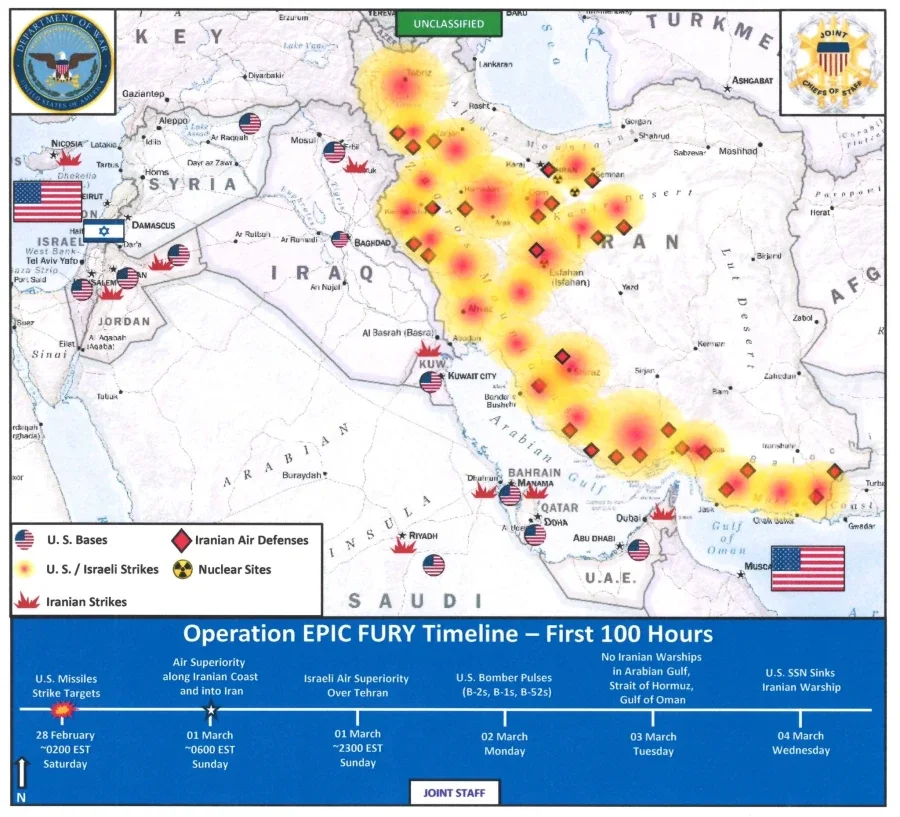
The most dramatic development occurred late in the evening of the same day, when the Israeli Air Force achieved complete air superiority over Tehran. This development marked the collapse of the Iranian protective umbrella over decision-making centers, leaving the capital and surrounding military installations exposed to continuous attacks.
The speed with which the Iranian air force was neutralized was crucial to the continuation of operations, as it allowed for the safe coordination of future phases.
72 hours later
Monday, March 2, marked the entry of strategic bombers into the arena. Successive waves of raids, involving B-2, B-1, and B-52 aircraft, unleashed unprecedented firepower against Iran's network of nuclear facilities. Sites in Qom, Arak, and Isfahan were repeatedly struck with the goal of permanently disabling the country's nuclear program.
At the same time, the red diamonds on the operational map, representing air defense positions, began to fade one by one, as the operation evolved into a systematic dismantling of every military infrastructure. The use of stealth bombers allowed for the precise attack of fortified targets previously considered impregnable.
Closing of 100 hours
On Tuesday, March 3, the focus shifted to the sea, with the US fleet implementing a full naval blockade. Within hours, it was reported that there were no more active Iranian warships in the Arabian Gulf, the Strait of Hormuz, and the Gulf of Oman.
The elimination of the Iranian naval presence ensured freedom of navigation and ruled out any possibility of using Tehran's naval forces for asymmetric attacks on merchant ships. The strategic importance of the Strait of Hormuz passed completely under the control of the Western coalition, neutralizing one of Iran's strongest currencies in the negotiations.
This first 100-hour phase concluded on Wednesday, March 4, with a final display of operational capability. A U.S. nuclear-powered submarine found and sank the last major Iranian warship still at sea.






Lini një Përgjigje