


 Shkruar nga Pamfleti
The Albanian Investment Corporation has become a key instrument for the isolation and transfer of public property to private interests, through closed negotiations, lack of competition and transparency. From Vrinë to stadiums, the Palace of Congresses and other strategic projects, the decisions of the KSI have raised the alarm for money laundering, setting in motion even the State Department...
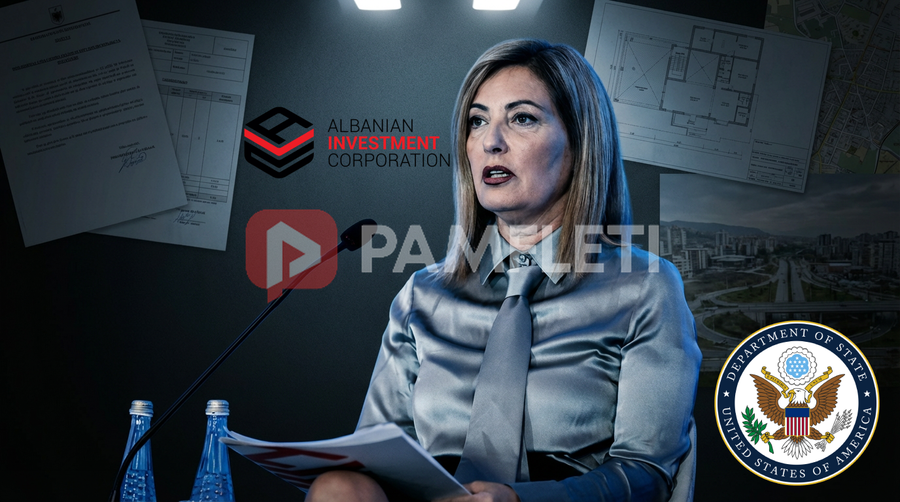
There is no longer any doubt that the Albanian Investment Corporation has become one of the most dangerous instruments of power for the alienation of public property, a mechanism specifically built to remove institutional control, to avoid classic competition procedures and to transfer the strategic assets of the Albanian state into predetermined private hands. At the head of this structure that acts as a buffer between politics, big business and suspicious capitals stands Elira Kokona, director of the Corporation, appointed and politically protected by Prime Minister Edi Rama.
What is happening today with the KSI is not a theoretical debate on development or investment, but a concrete, documented and repeated process, where public property is isolated, administratively blocked, declared “of development interest” and then entered into closed negotiations, away from the public eye, away from competition and away from any transparency standards. This very scheme has also set in motion the United States of America, which has announced an in-depth audit of the towers, PPPs, tenders and state structures that manage public assets, including those that act as property intermediaries, by the deadline of March 28, 2026.
At the center of this mechanism is the Albanian Investment Corporation, a structure that on paper was created to increase the value of state property, but which in practice has been transformed into a negotiating office for the transfer of this property to private interests. Elira Kokona, as executive director, is not simply a technical administrator. She is the person who signs the papers, coordinates the Cadastre, opens and closes the “verification” processes, and manages communication with potential investors, holding the real keys to the territory.
The case of Vrinë is the most brutal example of this scheme. By a Decision of the Council of Ministers dated November 20, 2024, the Albanian Investment Corporation was authorized to coordinate the process of identifying state property of interest for investment in the village of Vrinë, Konispol Municipality. On paper, it is a technical process. On the ground, a gigantic area of 849 hectares, in one of the most strategic areas of southern Albania, bordering the Butrint Park and Greek territory, was placed under a dark administrative regime, where registrations in the Cadastre were blocked, real owners were kept in suspense and the land was taken out of normal legal circulation.

This is not a procedural detail but the moment when the property loses its legal protection and becomes an object of bargaining. Investigative sources have reported that large amounts of capital have entered this territory, including entities linked to international drug trafficking and individuals based in Dubai, who are suspected of having blocked amounts of 20 to 30 million euros in properties distributed within the Vrina area. The question is not whether this money exists, but who has opened the legal path for it, who has guaranteed the administrative blockade of the territory and who is preparing the ground for this capital to be legalized through pre-prepared luxury projects.
All these cases, from Vrina, to the “Selman Stërmasi” stadium in Tirana, the “Niko Dovana” stadium in Durrës, the Congress Palace, “Expo Albania” and Durana Tech Park; are not isolated episodes, but decisions taken under the same administration model, where public property passes under the control of the Albanian Investment Corporation, is isolated from normal legal circulation and is placed in special “development” regimes, becoming a negotiating asset for private interests. In each case, we have the same scheme: lack of competition, lack of transparency on property valuation, centralized decision-making and avoidance of classic competition procedures, elements that create suitable terrain for abuse and money.

It is precisely on the specific contracts, the procedures followed, the method of selecting private partners and the real division of benefits between the state and the private sector that we will focus in the next article, because that is where the answers that are currently kept out of public attention and that reveal how the decisions of the KSI have been transformed into an instrument for the alienation of state property are located.
The Albanian Investment Corporation does not operate in a vacuum nor outside the state hierarchy. It is directly subordinate to the Ministry of Economy, Culture and Innovation, an institution currently headed by Blendi Gonxhja, a minister who holds political responsibility for every territory placed under development regime, for every administratively isolated public property and for every closed negotiation process that takes place under the umbrella of the KSI.


No responsible minister can claim not to know what happens to public property administered by a corporation under his or her control, especially when these processes are accompanied by cadastral blockages, lack of competition, lack of transparency, and negotiations that take place away from the public eye. If Elira Kokona is the figure who implements this model on the ground, the ministry led by Blendi Gonxhja is the structure that keeps it politically afloat and allows it to function without any real control filter.
This is why the money laundering alarm is directly related to the way public property is being managed through the KSI. Development models such as towers, resorts, mixed-use projects and transformations of public territories into private construction assets are, according to international practices, among the most used mechanisms for the legalization of capital of criminal origin, especially when accompanied by a lack of transparency and institutional control. It is precisely these elements that have also set in motion the US Department of State, which has announced an in-depth audit of towers, PPPs, tenders and state structures that administer public property, within the deadline of March 28, 2026.
This is not a formal warning nor a routine diplomatic signal. It is a clear indication that the Albanian model of development, based on the alienation of public property and closed negotiations, is now seen as a serious risk for money laundering and the capture of institutions. (Continued)... /Pamphlet





Lini një Përgjigje