


 Shkruar nga Pamfleti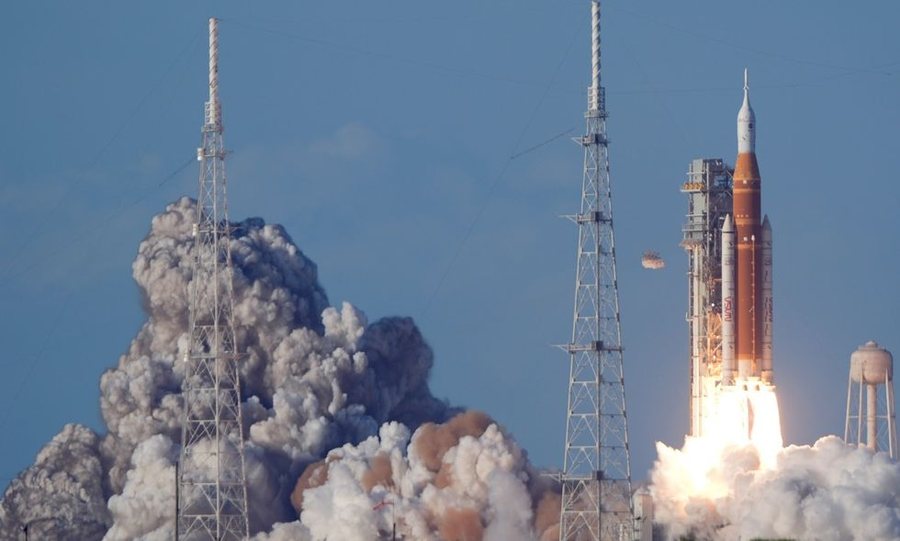
Orion spacecraft enters Earth orbit after successful NASA launch
NASA's Artemis II mission has been successfully launched and the spacecraft is now in orbit around Earth.
Four astronauts lifted off in the early hours of the morning from Florida for the Artemis II mission, a high-profile trip around the moon that marks the United States' boldest step yet to return humans to the lunar surface, in a race with China for space dominance.
NASA's Space Launch System (SLS) rocket, carrying the Orion capsule, blasted off just before sunset from the Kennedy Space Center in Cape Canaveral, Florida, sending its first crew – three Americans and one Canadian – into orbit around the Earth. The spacecraft, as tall as a 32-story building, blasted off into the clear sky, leaving a large column of white vapor behind.
Tens of thousands of people gathered to witness the moment, filling the surrounding streets and beaches, in an atmosphere reminiscent of the Apollo missions of the 1960s and 1970s. This is considered NASA's biggest step yet towards establishing a permanent presence on the Moon.
"On this historic mission, you carry with you the heart of the Artemis team, the courageous spirit of the American people and our partners around the world, and the hopes of a new generation," said launch commander Charlie Blackwell-Thompson, shortly before liftoff.
"Success and safe travels, Artemis II. Let's get going."
Five minutes after liftoff, Commander Reid Wiseman reported, “We have a beautiful moonrise, we’re heading for it.” On board are pilot Victor Glover, Christina Koch, and Canadian Jeremy Hansen. This is the most diverse crew in the history of lunar missions, including the first woman, the first black astronaut, and the first non-American citizen in such a capsule.
“It’s a great view,” Wiseman said during the climb. “It’s incredible to be at this altitude.” NASA Administrator Jared Isaacman said after the launch that the agency had returned to manned missions to the Moon, calling the half-century hiatus temporary.
According to officials, the crew is “safe, secure and in very good spirits.” They will not land on the Moon during the 10-day mission, but they will orbit it and may travel farther from Earth than any human has before.
The spacecraft will remain in orbit for the first 24 hours for technical checks. If all goes according to plan, it will receive approval to head towards the Moon. The launch was not without challenges, due to several technical problems before the flight.
The crew encountered some minor issues, including sensors in the waste management system that gave unexpected readings. Engineers worked with the astronauts to perform additional checks and reconfigure the system.
Orion has backup systems, so these issues are more about comfort and long-term operation than immediate danger. NASA stressed that it will intervene if the situation worsens.
Mission control confirmed that the system was operational and advised the astronauts to wait for stabilization before use.
The crew's sleep will be divided into two phases: about four hours of initial rest, followed by an orbit stabilization maneuver, and then about another four and a half hours.
Several other issues were also identified: a closed water valve that should have been open and a temporary electronic outage, similar to that of the Artemis I mission. None of these are considered a threat to the mission.
The astronauts will study the lunar surface in detail for about three hours during the mission. They will also test the manual control of the Orion capsule and conduct rehearsals for future maneuvers.
They will then travel thousands of kilometers beyond the Moon to test vital systems, including life support, propulsion, power and navigation. The crew will also participate in medical experiments, sending back data and images from deep space.








Lini një Përgjigje