


 Shkruar nga Massimiliano Coccia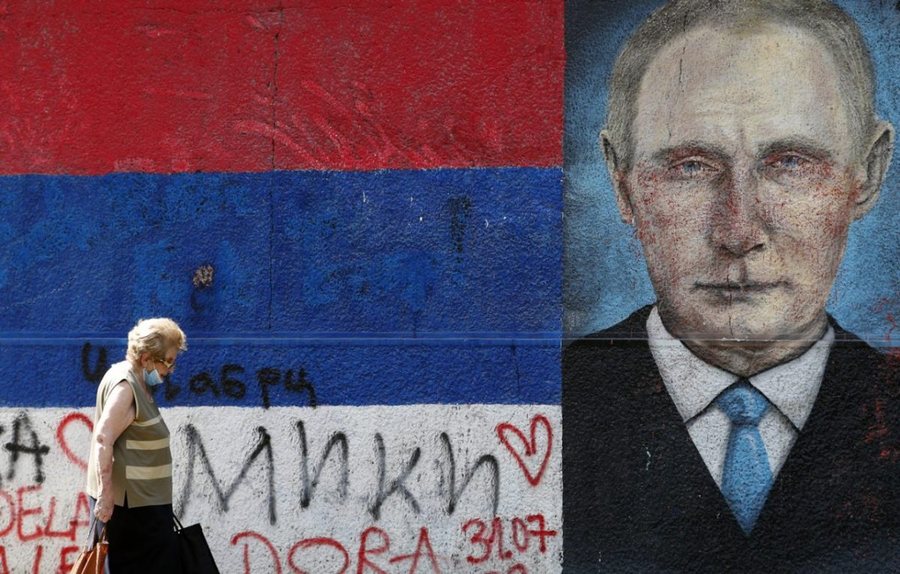
According to a source from the French intelligence services, the Russian regime contacted about 2,000 people from various European countries, and 20 of them (including 9 French), present on Instagram and TikTok, had accepted payments for advertising in favor of Russia.
The sanctions through which Europe aims to paralyze the economic, financial and informational assets of Vladimir Putin's Russia are a complex and constantly changing issue, both for goods, dual-use goods, energy but also for large technology companies ( Big Tech), which are managing a large volume of information and news constantly introduced into the circuit of networks and social platforms by entities that are on the sanctions list.
The Kremlin's propaganda infrastructures are many and varied, supported by entire teams of fraudsters. In this mission, Moscow uses the support of an important partner like Beijing, which shares the same strategy for saturating the informal information market.
But if on the one hand, after the approval of the new package that extends the sanctions to disinformation actions, the European institutions have launched investigations into the customers who carry out hybrid warfare actions, acting with delay, the big digital companies are failing to do anything.
In fact, as shown in the new report from the anti-disinformation network coordinated by Alliance4Europe and Science Feedback through the anti-disinformation network, a group of 8 civil society organizations and researchers, including FIDU (Italian Federation for Human Rights), has documented how Big Tech Platforms are failing to enforce European sanctions against Russian and Belarusian propaganda actors.
For example, Russian media officially under Western sanctions continue to freely publish content on Facebook. Even sanctioned Russian military companies promote their tanks on Instagram, while Russian public figures earn money from advertising on Telegram.
In addition, according to the report, there is another major problem that invalidates any filtering efforts: across all platforms, with the exception of TikTok, 83 percent of the accounts of sanctioned entities or individuals reported as still accessible in the European Union.
"The problem is not only the presence of sanctioned content on digital platforms, but their amplification by accounts acting as independents. The accounts we documented, including those in Italy, have significant influence, amassing millions of followers in total, many of them within the European Union.
This creates fertile ground for misinformation, and gives sanctioned entities and individuals the opportunity to continue spreading content that is manipulated and harmful to our society. Therefore, it is essential that the platforms address this phenomenon urgently, using appropriate tools to identify and limit the channels and amplifiers sanctioned and ensure compliance with European laws and the protection of the information space" - declares Eleonora Mongelli from FIDU.
The report states that 370 new cases of sanctioned content or previously unreported accounts have been identified. And disinformation operations centers have developed new strategies to avoid sanctions. In this context, some accounts already included in the blacklist are extracting economic benefits from the monetization programs of platforms such as Telegram, YouTube and Facebook.
The data in the report raises questions about the implementation of the Digital Services Act (DSA) and the possible impact that the violation of European regulations will have on sanctions. Omri Preiss, managing director of Alliance4Europe says: “Big Tech has a clear mission, which is to protect their platforms from information manipulation by authoritarian governments.
Every day, we see how crucial this is for the security of the democratic process across the European Union. The European Commission should create clear guidelines for platforms to successfully implement the Digital Services Act".
After the cases of Moldova, Georgia and Romania, it seems essential to curb the phenomena of propaganda and cognitive misinformation, not only immediately before the electoral processes, but also during public life, a challenge for legislators and content creators.
Éric Percheron, associate researcher at the French Institute for International and Strategic Affairs, says that "this report highlights the challenges of implementing international sanctions in the field of information or disinformation".
The report's authors shed light on a key aspect of hybrid warfare: the unfettered access to propaganda content facilitated by platforms and VPNs. The manipulation of information through TikTok and the recent cancellation of the presidential election in Romania remind us of the power of voices in the digital age.
Le Monde recently reported that French intelligence services have discovered a manipulation operation on social networks launched by the Kremlin in the spring of 2022, after the start of the Russian invasion of Ukraine.
According to a source from the French intelligence services, the Russian regime contacted about 2,000 people from various European countries, and 20 of them (including 9 French), present on Instagram and TikTok, had accepted payments for advertising in favor of Russia. The overlap between the digital and real worlds is now a proven fact, and perhaps the intensity of the hybrid war shows how the battlefield is not only virtual./ Adapt Pamphlet from "Linkiesta"






Lini një Përgjigje